
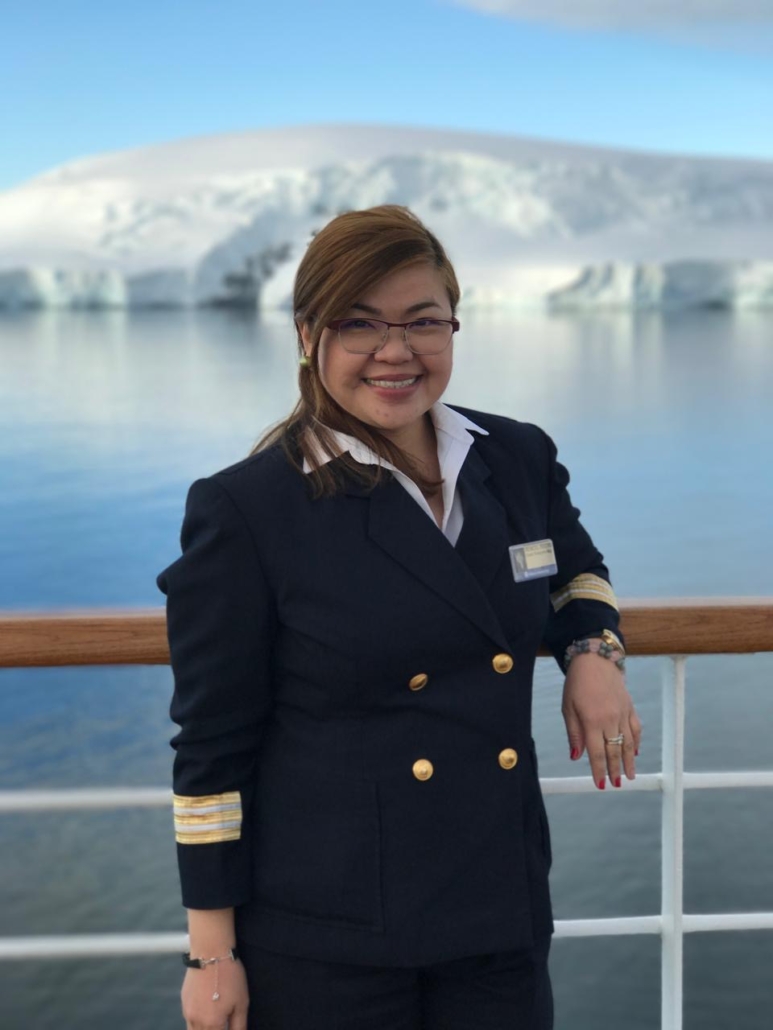
Across the Maritime Industry, Rencel Recto Charts Her Own Course
This May, Blue Orange Wave puts a spotlight on seafarer wellbeing, inclusion, and community with a series of posts highlighting themes of mental health and women in maritime.
This International Day for Women in Maritime, Blue Orange Wave puts a spotlight on the women who have made strides in leadership within the maritime industry. Today, we are proud to feature the innovative and empowering work of our very own Chief Operating Officer, Rencel Recto.
Rencel Recto has spent more than two decades in the maritime industry—first as a seafarer in the cruise sector, working her way through leadership roles onboard, and today as Chief Operating Officer of Blue Orange Wave. She knows the maritime industry not from the outside looking in, but from the inside out, and when she speaks about the crucial role of women in maritime, she speaks from the position of someone who has both lived its challenges and made it through.
Maritime has long been a male-dominated industry and while more women are entering the field today, Rencel is clear-eyed about where the real difficulty lies. Last year, the International Maritime Organization reported an ongoing gender disparity in the sector which has been increasing over the years. Among the surveyed organizations, women comprise a mere 19% of the total maritime workforce.
Furthermore, the focus on diversity goes beyond fairness and equity. Diversity is critical to innovation, acting as a key driver to problem-solving. Research shows that companies with a diverse management team see up to almost 20% higher innovation outcomes. By bringing together varied perspectives, backgrounds, and experiences, diverse teams avoid homogeneous “groupthink,” leading to faster, more creative solutions—a benefit that is crucial for the maritime industry as it navigates complex global challenges and technological transformation.
Entering the maritime industry, however, is not the hardest part. “The biggest barrier is not opportunity at the start, but sustained support over time,” Rencel says. “Welcoming women onboard is one step, but ensuring they are given equal access to development, mentorship, and leadership pathways over time is what truly enables women to reach higher-ranking positions.”
This distinction matters. Representation at entry level is not the same as equity in progression. For Rencel, meaningful inclusion has to be lived throughout an organization, from shipowners and senior leadership down to onboard crews, and it has to rest on something foundational to the industry: safety. When women feel physically and psychologically safe at work, they can perform at their best, contribute with confidence, and build careers that last.

There has been growing advocacy around diversity and inclusion in the industry, and Rencel welcomes it. But she’s careful to distinguish advocacy from action. True progress, she argues, isn’t measured by diversity targets or representation figures — it’s measured by whether women who join the industry are able to stay, grow, and lead. From her own experience, the women who thrive at sea bring resilience, adaptability, sharp attention to detail, and emotional intelligence — qualities that aren’t just valuable, but essential in the high-pressure, multicultural environments that define maritime work.
“True progress,” Rencel says, “is when women are not only present, but are able to grow, lead, and thrive — based on their capability.” Rencel’s journey — from seafarer to COO — is proof that it’s possible. But she’s also honest that the path required more than talent; it required an industry willing to invest in her, and environments where she could develop without having to fight simply to belong. That’s the standard she holds, and the standard she works toward every day.

